

Products
View All ProductsTrailer Movers
Electric Tugs & Movers
If you need some help choosing a product or would like to book a demo, please get in touch using the link below:
Custom Electric Tugs

Applications
View All Applications
Super Power Pusher pushing metro cars at Helsinki Public Transport maintenance depot.

Power Pusher, with Roller Attachment, for pushing cable drums at Prysmian Cables.

Super Power Pusher, with Steering Arm, moving chemical ISO container into and out of wash bay.
About Us
Looking for a Power Pusher in your area?
Our electric tugs are sold globally through a network of helpful distributors.
Applications
Controlled movement of machinery, equipment and other heavy loads supported on industrial machine skates.


Electric Tugs for Moving Heavy Loads on Machine Skates
Move machinery, generators, steel fabrications and other heavy equipment on industrial skates with less manual effort and more precise control.
Power Pusher electric tugs provide a compact, battery-powered solution for moving heavy loads supported on machine skates. They are particularly useful during machinery installation, factory relocation and maintenance projects where loads need to be moved carefully through restricted industrial spaces.
Solutions are available for loads weighing up to 60,000 kg, subject to rolling resistance and operating conditions. Standard and custom attachments can be selected around the load, skate arrangement, floor surface and available connection points.
What can the Power Pusher move on machine skates?
Industrial skates can temporarily mobilise loads that do not have their own wheels or castors. Combined with a suitable Power Pusher and attachment, they can provide a practical way to move heavy equipment during installation, relocation and maintenance work.
Factory and production machinery
Machine tools, presses, manufacturing equipment and complete production units.
Generators and power equipment
Heavy generators, transformers and associated electrical equipment.
Steel structures and fabrications
Large fabricated assemblies, frames and structural components.
Modular structures
Temporary buildings, modular units and prefabricated structures.
HVAC and plant equipment
Air-conditioning units, pumps, compressors and other plant-room equipment.
Containers and specialist loads
Shipping containers and unusual industrial loads temporarily supported on skates.
The most suitable solution depends on more than the load weight. The skate arrangement, floor condition, gradients, required direction of travel and method of connecting the tug must all be considered.

Why use an electric tug with machine skates?
More controlled movement
Variable-speed operation helps the operator start the load progressively and make smaller adjustments when approaching its final position.
Less manual pushing
Powered movement reduces the need for a team of people to physically push heavy machinery across the floor.
Compact and transportable
Power Pusher machines are self-contained and battery powered, with no trailing power cables or compressed-air lines.
Suitable for restricted industrial spaces
A pedestrian-operated electric tug can be useful where there is insufficient room to manoeuvre a forklift or other large equipment.
Standard and custom attachments
The connection can be selected around the machinery, available contact point and required direction of movement.
Purchase and hire options
Machines can be purchased for regular use, while short-term and weekend hire may suit individual installation or relocation projects.
Moving machinery without relying on manual force
Machine skates are commonly used to make heavy equipment temporarily mobile during installation, relocation or maintenance work. Once a load has been lifted and positioned on the skates, it still needs enough controlled force to start moving and travel into position.
Manual pushing may require several people and can become difficult to control, particularly when the load is heavy, access is restricted or accurate positioning is required. Pulling the load with a hand-operated winch can also be slow and requires a suitable anchoring point ahead of the load.
A Power Pusher applies powered movement directly to the load, helping reduce the physical effort required from the installation team while giving the operator variable-speed control.
Connecting the electric tug to a skated load
The correct attachment depends on the shape of the load, its available contact points and the direction in which it needs to move. An angle-bracket attachment is commonly used for machinery installation and for applying force to loads supported on industrial skates.
Some applications can use a standard attachment, while unusual machinery or restricted access may require a custom bracket, extension or connection arrangement. The contact point must be capable of accepting the pushing force without damaging the equipment or allowing the tug to slip out of position.
The industrial skates themselves remain responsible for supporting and carrying the load. The Power Pusher provides horizontal movement and does not lift the machinery or replace the equipment needed to raise it safely onto the skates.
Need an electric tug for a one-off machinery move?
Not every machinery installation or relocation project requires a permanent equipment purchase. Short-term and weekend hire options are available for suitable applications, giving contractors and installation teams access to powered movement for a specific project.
Tell us what needs to be moved, the approximate weight, the type of skates being used and the conditions on site. We can help establish whether hire is appropriate and which machine and attachment may be required.
Choosing the right Power Pusher
The right electric tug cannot be selected from load weight alone. The force required will also depend on the type and condition of the machine skates, the floor surface, gradients, changes in direction and the point at which force can safely be applied to the load.
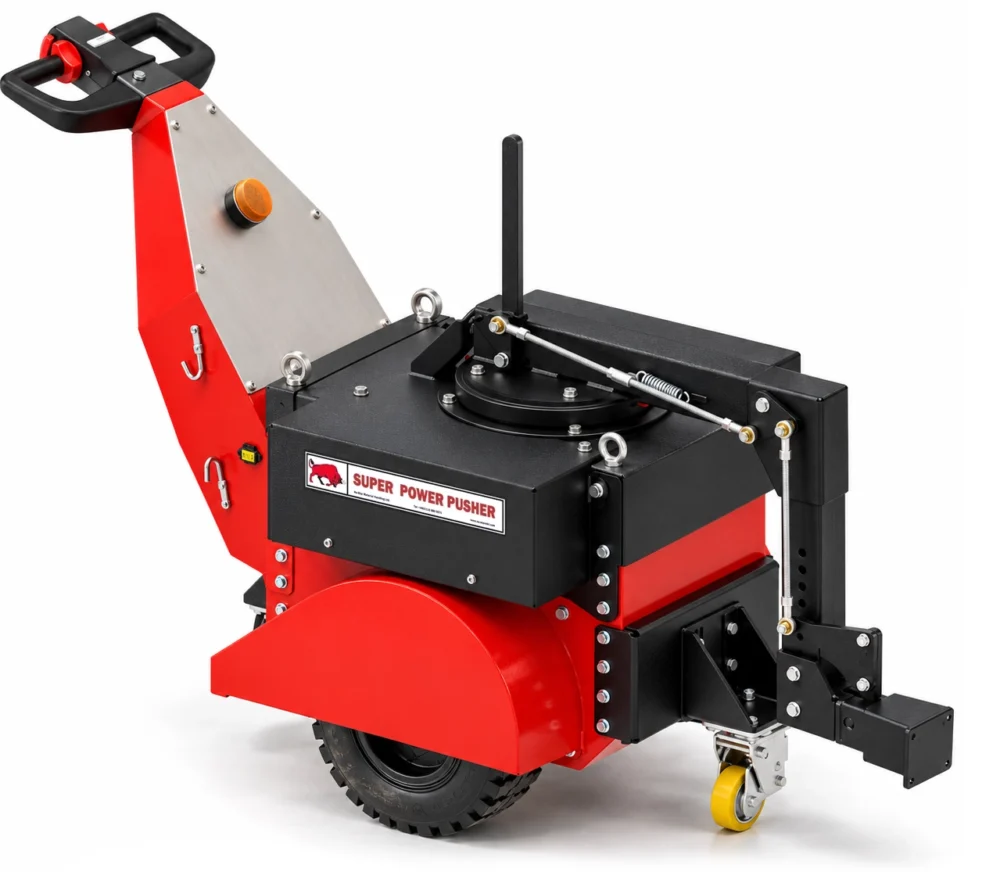
The Power Pusher, Super Power Pusher and Dual Motor Super Power Pusher provide increasing levels of pushing force for machinery-moving applications. Our team can review the load and working environment to recommend a suitable machine and attachment.


Frequently Asked Questions
Power Pusher models are available with stated load capacities of up to 60,000 kg. However, that figure should not be treated as a guarantee that any load of that weight can be moved.
The actual force required depends on the rolling resistance of the skates, their wheel material and condition, the number and arrangement of the skates, the floor surface and any gradients or thresholds along the route. A lighter load on small or damaged rollers may be more difficult to move than a much heavier load on correctly selected skates over a smooth, level floor.
Each application should therefore be assessed using the complete load and site conditions, rather than the machinery weight alone.
We will usually need the approximate total load weight, the number and type of machine skates, the condition and material of their rollers, and details of the route over which the machinery will travel.
It is also important to understand the floor surface, gradients, joints or thresholds, required changes in direction and the available contact point on the load. Photographs, drawings and a short video of the equipment and route can help identify access or connection issues.
Where rolling resistance cannot be established reliably, a site assessment or practical test may be recommended before a machine is specified.
No. A Power Pusher is designed to apply horizontal pushing or pulling force once the load is properly supported on suitable skates. It does not lift the machinery or replace hydraulic jacks, lifting gantries, cranes or other equipment required to raise and lower the load.
The lifting method, skate capacity and stability of the load should be planned separately by a competent machinery-moving team. The electric tug is then introduced as part of the horizontal movement process.
That depends largely on the skate arrangement. Some machinery-skate systems include steerable front skates or a turntable, while others are designed mainly for straight-line movement. The way the load changes direction must be considered before selecting the tug and attachment.
A Power Pusher can provide controlled force and assist with positioning, but it cannot make a fixed skate arrangement steer in a way it was not designed to. The location of the skates, the load’s centre of gravity and the available turning space all need to be considered as part of the movement plan.
An angle-bracket attachment is commonly used to apply pushing force to machinery or equipment supported on industrial skates. The precise attachment will depend on the shape and strength of the available contact point, the height at which force should be applied and the required direction of movement.
Some loads can be handled with a standard attachment, while others may need a custom bracket or extension. The aim is to create a secure and effective contact point without damaging the machinery or allowing the tug to move out of position during operation.
Need help choosing the right product?
If you need help with choosing a product from the Power Pusher range or need advice, please complete the form below, and we will get in touch with you as soon as possible. To attach images/drawings to help with your enquiry please use our detailed enquiry form.


