

Products
View All ProductsTrailer Movers
Electric Tugs & Movers
If you need some help choosing a product or would like to book a demo, please get in touch using the link below:
Custom Electric Tugs

Applications
View All Applications
Super Power Pusher pushing metro cars at Helsinki Public Transport maintenance depot.

Power Pusher, with Roller Attachment, for pushing cable drums at Prysmian Cables.

Super Power Pusher, with Steering Arm, moving chemical ISO container into and out of wash bay.
About Us
Looking for a Power Pusher in your area?
Our electric tugs are sold globally through a network of helpful distributors.
News & Updates
Power Pusher vs forklift trucks: do you actually need to lift the load?
Walk into most factories, depots or maintenance workshops and you’ll find a forklift doing something that has nothing to do with lifting. It may be moving a laden trolley to the paint bay, repositioning a stillage or pulling a kiln car from an autoclave or just about anything that is either too heavy or too awkward to be moved by hand, or the distance and/or frequency of movement is regarded as too arduous.
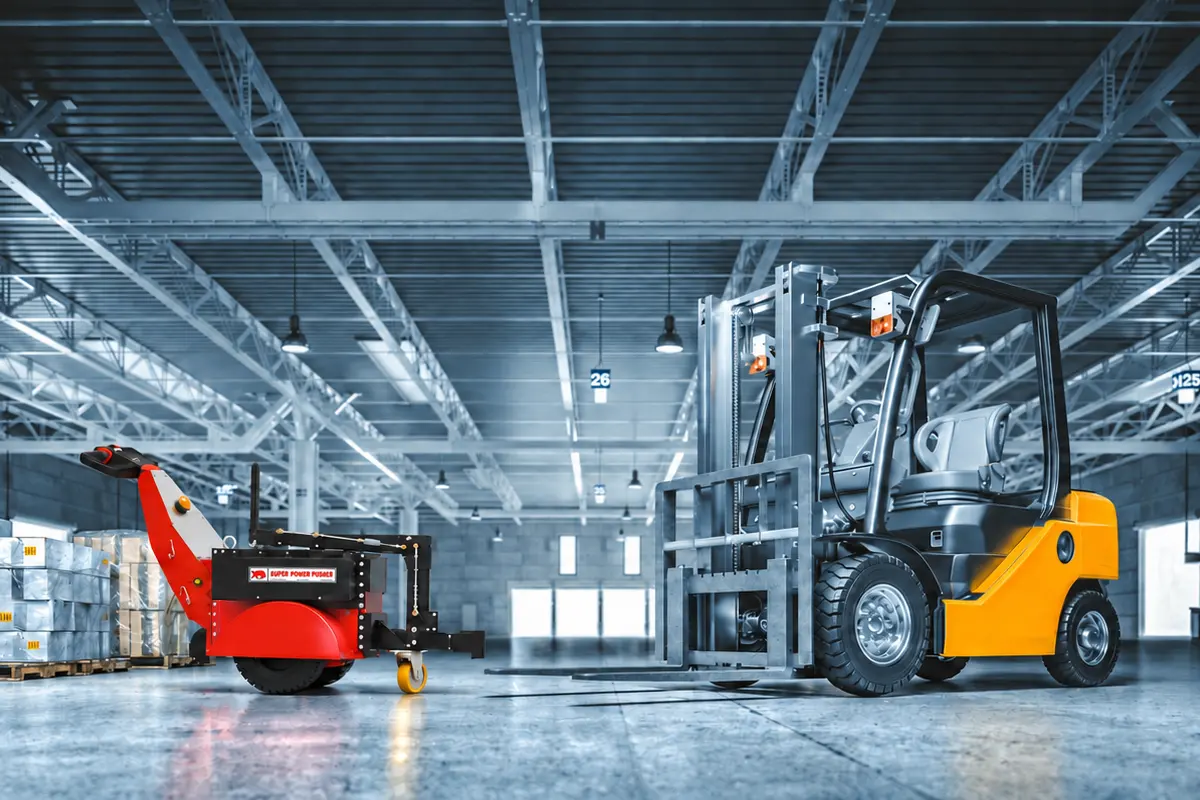
It’s right, a forklift may do the job. That doesn’t make it the best or indeed safest tool for it. Forklifts are built to lift, carry and stack. A Power Pusher applies controlled force to push, pull or reposition a compatible wheeled load at ground level. Once you see that difference, the choice gets a lot simpler.
The question isn’t whether Power Pusher electric tugs are better than forklift trucks…
The determing question should be: “Does this load need to be lifted, or simply moved?”
Start with the job, not the machine
A forklift earns its place when goods must be raised from the floor, placed in racking, stacked, loaded onto a vehicle or carried on forks. It combines horizontal transport with vertical lifting.
Many internal movements don’t require that second function. A loaded production trolley may only need to travel 40 metres. A maintenance platform may need moving into a bay. A process vessel may need accurate positioning beside a line. Machinery may already be sitting on industrial skates.
For these jobs, you’re paying for lifting capacity you don’t use. You still pay to buy or hire the forklift, keep it available, train and authorise operators, maintain it and meet the requirements that apply to lifting equipment.
A pedestrian electric tug is designed around the horizontal move. The operator walks with the machine and the load stays on its wheels, castors, skates or rails. The tug can therefore be much smaller than the vehicle that would otherwise lift and carry the same load.
Nobody’s saying scrap your forklifts. Just save them for work that actually needs forks.
Where a Power Pusher can be the more practical choice
The clearest opportunities tend to be repeated ground-level movements involving a known load and route. The load must be suitable for powered pushing or pulling and there must be a secure way to connect to it or apply force.
Power Pusher applications include loads on trolleys and carts, rail bogies and transfer cars, machinery on skates, cable drums and paper reels, process vessels and trailers. These aren’t interchangeable jobs. Each needs the right machine and attachment.
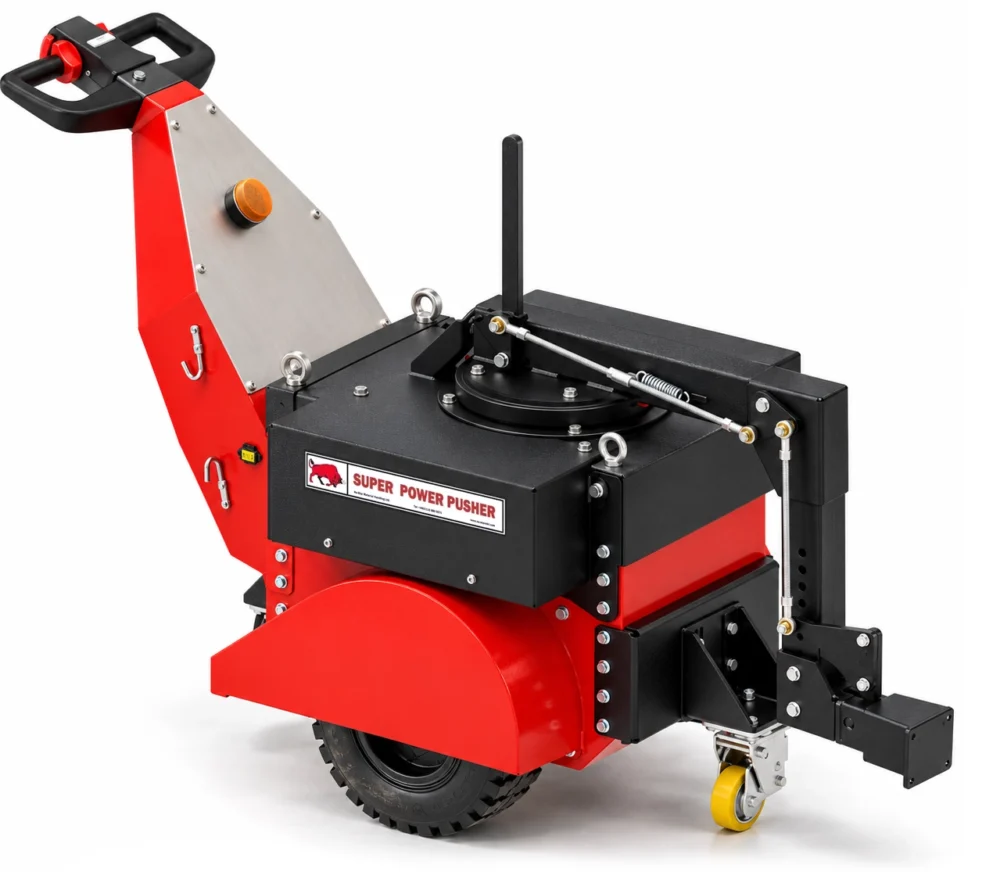
For example, the Power Pusher and Super Power Pusher can use a Steering Arm to connect to and steer suitable industrial trolleys. The Dual Motor Super Power Pusher provides more pushing force for heavier or higher-resistance applications. The PowerTug is designed for vessels, tanks and other equipment fitted with swivel castors, where the load can wander as the castors react to cambers or uneven floors. Roller attachments are available for pushing cable drums and paper reels. An angle bracket can apply force to suitable loads supported on industrial skates.
These are established industrial applications. Power Pushers have moved kiln trolleys at Churchill China, cable drums at Prysmian and rail bogies in a London Underground maintenance depot. They have also handled excavator booms on mobile stillages and heavy production trolleys. The common thread is a load that’s already mobile, stays at ground level and needs controlled movement rather than lifting.
Often the real gain is control in tight spaces. A compact pedestrian machine needs less room of its own than a counterbalance forklift. The operator can work close to the load and, with the right operating method, see the route and final position directly. That can help when approaching a production station, passing through a doorway or manoeuvring around fixed plant.
Using the right machine for the right application will also help achieve segregation of forklifts from pedestrians on the shopfloor and therefore minimise the risk of accidents.
The hidden cost of using a forklift for a non-lifting task
There’s no honest one-size figure for how much a Power Pusher saves over a forklift. Purchase price, duty cycle, power source, attachments, finance, servicing and site conditions vary too much. A fair comparison looks at what one specific move costs over the life of the equipment.
| Cost area | Forklift used for horizontal movement | Power Pusher used for a suitable wheeled load |
|---|---|---|
| Equipment | The price includes a mast, forks, counterweight and lifting system, even when the task uses none of them. | The machine is specified for pushing, pulling or positioning the load. |
| Operator provision | Lift-truck operators need appropriate staged training, assessment and workplace authorisation. | Tug operators still need instruction and competence, but training can be specific to the simpler machine, load and route. |
| Inspection and compliance | PUWER applies. Lifting operations and lifting equipment are also subject to LOLER requirements, including thorough examination where applicable. | PUWER still applies. A machine used only for horizontal movement will not normally be lifting equipment, although the exact configuration and use must be checked. |
| Maintenance | Costs can include the lifting system, mast, hydraulics, tyres, brakes, battery or engine and other vehicle systems. | Servicing is focused on a smaller battery-powered machine, its drive, controls, batteries and attachment. |
| Energy | Depends on whether the truck is diesel, LPG or electric, its size and utilisation. | No emissions/carbon-friendly battery-electric operation powers a smaller, task-specific machine. Actual consumption depends on the load, route and use. |
| Space | The site must allow for the truck’s dimensions, turning area, parking and any charging or fuel arrangements. | The Power Pusher usually has a smaller storage and operating footprint, but the load’s full swept path still governs aisle and turning requirements. |
| Utilisation | A forklift may be tied up on transport work while another team waits for a lift. | A dedicated Power Pusher can handle the repeat ground-level move and leave the forklift available for lifting tasks. |
The last point is easy to miss. The cost isn’t only what the forklift consumes during the move. It’s also the value of the lifting resource that can’t be used elsewhere. If production staff regularly wait for an authorised forklift operator, or lifting jobs queue behind trolley movements, assigning a tug to the repeat route may remove that conflict.
Training and operator competence
Both forklifts and electric tugs are work equipment. Under PUWER, employers must make sure equipment is suitable, maintained and used by people who have received adequate information, instruction and training. The detail will depend on the machine, the task and the conditions in which it is used. HSE’s guidance on training and competence explains the employer’s responsibilities.
Power Pusher operators need to understand the controls, attachment, load, route, stopping method, trapping points, local rules and what to do if conditions change. Familiarisation should use the actual loads and routes they will encounter. We offer on-site electric tug training, but responsibility for competence and safe use remains with the employer.
LOLER applies to work equipment used for lifting or lowering loads. A tug that only moves a load horizontally will not normally come within that definition. Some equipment or attachments may lift part of a load to create a connection or transfer weight, so buyers should confirm the position for the exact configuration and intended use rather than relying on a general label. PUWER requirements still apply either way. HSE’s LOLER overview provides the regulatory definition.
Smaller equipment changes the movement, not the need for assessment
A Power Pusher is smaller and lighter than a forklift, but the correct comparison includes the load as well as the machine.
The tug’s footprint can make close positioning easier and reduce the space occupied by the powered unit. But a long stillage or wide trolley may still need a large turning envelope. An operator walking with the load may gain a useful view of its corners, while still facing blind spots created by the load itself. Route design and a practical trial matter more than general claims about visibility.
Floor loading needs the same care. Replacing a heavy forklift may remove its axle loads from the route, but the wheeled load continues to transfer weight through its own castors, wheels, rails or skates. Small, hard castors can create high local contact loads. Floor capacity, joints, thresholds and finishes should be checked for the complete moving system.
Battery-electric Power Pushers produce no exhaust emissions at the point of use. That’s useful indoors, particularly when the alternative is a diesel or LPG truck.
A wheeled load isn’t automatically a suitable load
The total weight is only the starting point. A heavy rail bogie on clean steel rails will require less force to move than a much lighter trolley on castors.
Suitability depends on the force required to start, keep moving and stop the load. Wheel diameter, material and condition affect that force. So do bearings, load distribution, floor finish, debris, gradients, cambers, thresholds and tight changes of direction. HSE’s guidance on assessing pushing and pulling also makes clear that starting force can be greater than the force needed to keep a load moving.
The connection is just as important. An electric tug needs a secure attachment or an appropriate contact point that can accept the applied force without disconnecting, slipping or damaging the load. The operator must be able to control the load in both normal use and foreseeable fault conditions.
So don’t treat a quoted maximum capacity as a promise that the tug can move anything of that weight. Power Pusher capacities depend on rolling resistance. For a heavy, unusual or route-sensitive load, a site assessment and practical demo are the sensible way to confirm the model, attachment and operating method.
Where the forklift remains the right choice
Use the forklift when the job genuinely requires lifting, stacking or placing a load at height such as unloading palletised goods from vehicles, feeding high-bay racking or handling loads designed around fork pockets rather than wheels.
A forklift may also suit a mixed task where the load has to be picked up, moved and set down. Putting it on a trolley first would just add handling. It can also be the practical answer when a site already has spare forklift capacity, a suitable authorised operator and no repeat demand that justifies separate equipment.
Sometimes the best arrangement uses both. A forklift can handle pallet transfer or vertical placement in a controlled area, while a Power Pusher moves compatible wheeled loads along the repeat horizontal route. Each machine then does the work it was built for.
Which machine fits the job?
The deciding factor is whether the load needs to leave the ground.
If the job involves lifting from floor level, stacking, racking or placing at height, a forklift may be right. If the load stays on wheels and moves at ground level, a Power Pusher is worth testing.
Capacity alone won’t answer it. The load, route, floor, gradients and coupling all affect performance, so test the machine in the actual working area.



Frequently asked questions
It can replace a forklift for a defined movement where the compatible load stays at ground level and the electric tug can push, pull, steer and stop it throughout the route. It can’t replace the forklift’s vertical lifting and stacking functions. Some sites split the process, using a forklift in a loading or racking zone and an electric tug for repeat transport between production areas. The better question is often how much of the forklift’s workload can be moved onto equipment designed for horizontal transport.
For an appropriate horizontal movement, it can have a lower whole-life cost because the business isn’t buying and maintaining an unused lifting system or assigning a forklift and authorised operator to a simpler job. The result depends on specification and utilisation. Compare capital or hire costs, attachments, trolley modifications, energy, batteries, servicing, inspection, training, storage and labour over the same working life. Include the value of forklift time released for work that requires lifting.
A forklift can become a bottleneck when it covers both lifting and routine transport. Lifting work then waits behind trolley movements, or the site adds another truck to increase availability. A Power Pusher can take suitable horizontal movements out of that queue and keep the forklift available for pallet handling, loading and work at height. The case is strongest where the movement is frequent enough to justify dedicated equipment.
Not on its own. A Power Pusher applies horizontal force and doesn’t slide forks under a pallet. The pallet would need to be on a suitable wheeled trolley, dolly or other approved support, with a secure connection and a route that the complete load can travel safely. If the pallet must be lifted from the floor or put into racking, use suitable lifting equipment.
Don’t select from weight alone. Provide the total loaded weight, wheel or skate details, floor type, gradients, thresholds, route, movement frequency and available connection points. For unusual or high-resistance loads, measure the force needed to start and sustain movement or arrange a site trial. The right answer may involve a different model, a specific attachment, changes to the castors or, in some cases, a different type of handling equipment.
Test the movement with your actual load
Tell us the load weight, wheel or castor type, route, gradient and where the tug can connect. Our team can recommend a suitable Power Pusher and attachment, then arrange a practical demonstration to confirm how it performs in your working area.
For suitable applications, electric tug hire can provide a practical way to test the movement on your own floor before committing to a purchase.
Latest Updates
- Power Pusher vs forklift trucks: do you actually need to lift the load?
- Safer Paper Roll Handling in Paper Mills and Corrugator Plants
- Custom Electric Tugs: Tailored Solutions for Unusual Loads
- How the Power Pusher Range Can Support the Defence Industry
- Moving Heavy Loads on Rails Safely: Electric Tug Solutions for Rail Trolleys and Bogies
- Cable Drum & Paper Reel Handling: Safer Moving with Power Pusher Drum Pushers
- Hitachi Energy improves safe movement of production trolleys with the Super Power Pusher
- Material Handling Challenges in Manufacturing Facilities


