

Products
View All ProductsTrailer Movers
Electric Tugs & Movers
If you need some help choosing a product or would like to book a demo, please get in touch using the link below:
Custom Electric Tugs

Applications
View All Applications
Super Power Pusher pushing metro cars at Helsinki Public Transport maintenance depot.

Power Pusher, with Roller Attachment, for pushing cable drums at Prysmian Cables.

Super Power Pusher, with Steering Arm, moving chemical ISO container into and out of wash bay.
About Us
Looking for a Power Pusher in your area?
Our electric tugs are sold globally through a network of helpful distributors.
Applications
Push, pull, steer and position heavy trolleys, carts and dollies with full control, even in tight spaces.


Electric Tugs for Moving Loads on Trolleys and Carts
Moving a heavily loaded trolley or cart by hand is slow, tiring and a common cause of strain injuries. Power Pusher electric tugs let a single operator start, steer and stop trolley loads of up to 40,000 kg with precise control, with no forklift, no licence and no team of people pushing.
Our patented Steering Arm and automatic coupling fit your existing trolleys and carts, so you can keep the equipment you already have. From engine and machinery trolleys to kiln cars and press tool carts, Power Pusher trolley movers are used in factories, warehouses and production sites across the UK and worldwide.
What can the Power Pusher move on trolleys and carts?
Fitted with a Steering Arm and a simple coupling on the trolley, a Power Pusher lets one operator push, pull, steer and position laden trolleys, carts and stillages. It is used across manufacturing, engineering and specialist industries to move loads that are too heavy to handle by hand.
Engines, pumps and machinery
Diesel engines, industrial pumps and machinery moved on trolleys, including loads of 5,000 to 7,000 kg.
Production to despatch
Finished units and large assemblies, such as chillers and screen boxes, moved from production to despatch.
Automotive components
Trolleys loaded with automotive parts and assemblies moved around production areas.
Kiln and autoclave trolleys
Kiln trolleys moved into and out of autoclaves and kilns in the ceramics industry.
Construction plant components
Heavy plant parts, such as excavator booms, moved on mobile stillages during manufacture.
Oil, gas and nuclear
Drill pipe trolleys and heavy trolleys in nuclear facilities, including loads of up to 9,000 kg.
The most suitable solution depends on more than the load weight. The castor layout and condition, floor surface, ramps or slopes, and the space available to manoeuvre must all be considered.
Why trolleys need a different approach
A typical industrial trolley has two swivel castors at the front and two fixed castors at the back. That layout means it has to be moved and steered from the front.
Pushing from behind doesn’t work well. The swivel castors wander and the trolley drifts off line. Moving it backwards is harder still. To steer properly in both directions, the tug needs a solid physical connection to the trolley, which also prevents the tug and trolley separating while the load is moving.
Moving heavy trolleys by hand puts operators at risk, particularly when starting a load from standstill or stopping it on a slope. A Power Pusher takes that effort away. The operator controls the load with the tug rather than using body weight to force it. No forklift licence is needed, so anyone in the workforce can use it with training.
The patented Steering Arm
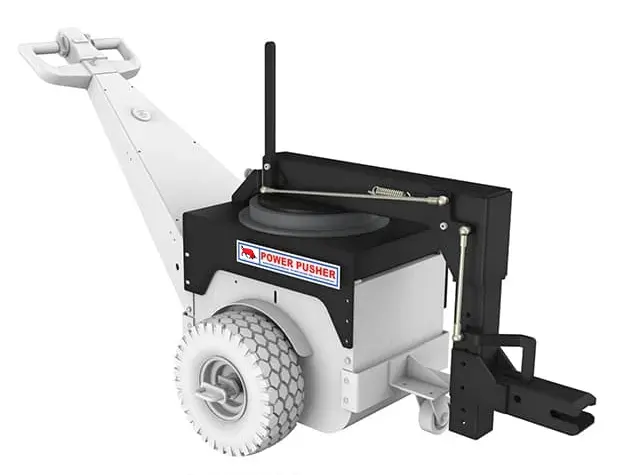
Our patented Steering Arm attachment sits on top of the tug and includes an industrial slewing ring, similar in principle to the fifth wheel on an articulated lorry. This lets the tug articulate relative to the trolley.
The operator can steer the trolley accurately, line it up with a workstation or doorway and place it exactly where it needs to go, forwards or backwards.

Secure, automatic coupling
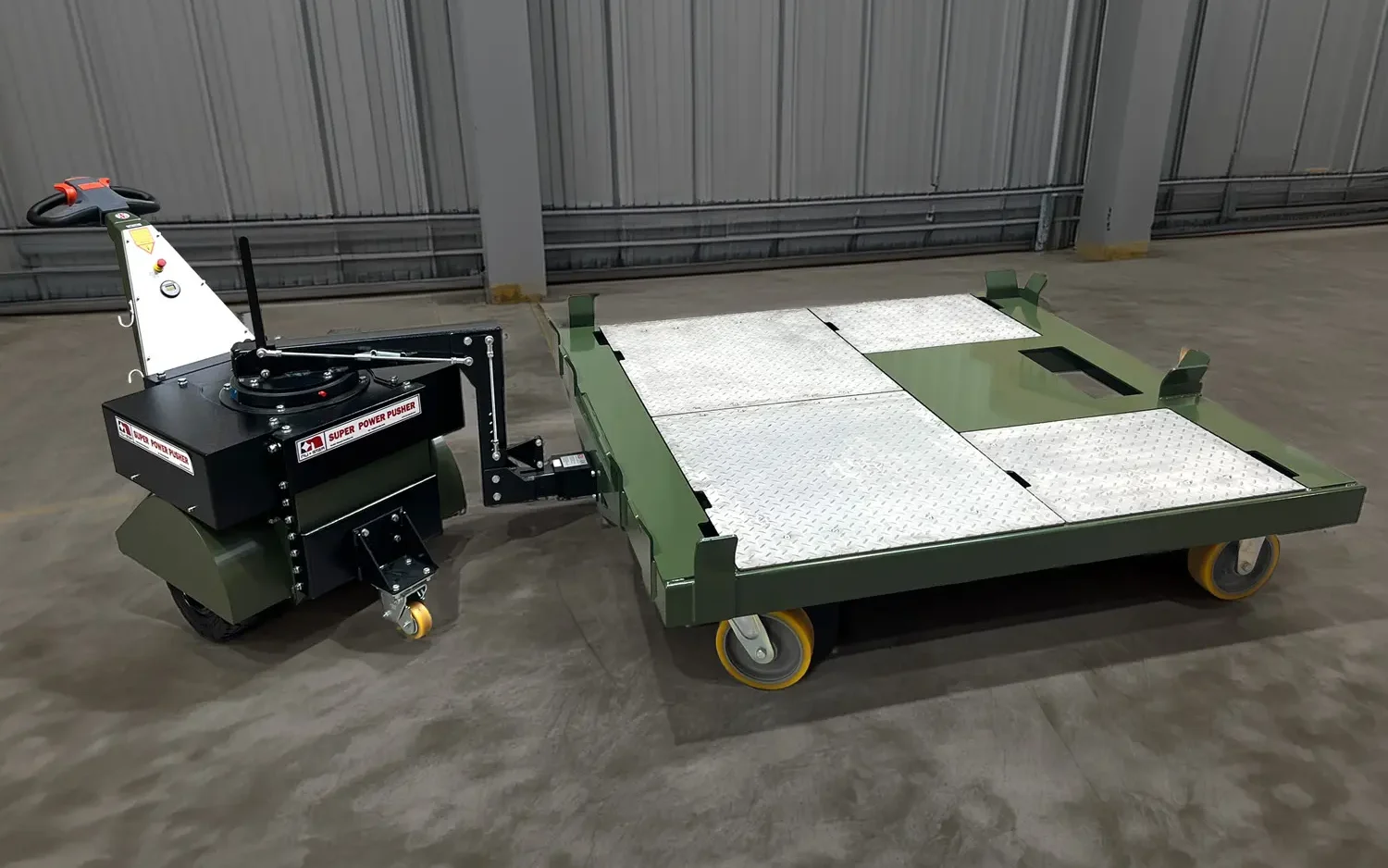
The tug connects to the trolley using a male and female coupling. The male part is on the tug, and the female part is bolted or welded to the trolley, cart or dolly.
To connect, the operator simply drives the tug towards the load. Disconnecting is just as quick, using a pull handle on top of the machine. The coupling is designed to tolerate ramps, slopes and undulations in the floor, so the tug stays securely connected along the route.



Case studies


Frequently Asked Questions
Power Pusher solutions are available for moving trolley and cart loads up to 40,000 kg. The right machine depends on more than weight alone though. Castor size and condition, floor surface, ramps and how often the trolley is moved all affect the force needed. A lighter trolley with worn or undersized castors can be harder to move than a much heavier one on good wheels. We’ll always look at the full application before recommending a model.
Only slightly. A female coupling is bolted or welded to each trolley you want to move. Once fitted, any tug with the matching Steering Arm can connect to it. In most cases the trolleys themselves don’t need any other changes.
Yes. Because the tug is securely coupled to the trolley, the operator can push, pull and steer in both directions. This is especially useful for reversing into bays, lifts or tight workstations.
Yes. If each trolley is fitted with the same female coupling, one tug can connect to all of them. This is a common setup for sites running a fleet of carts or cages.
The coupling is designed to tolerate ramps, slopes and undulations in the floor. We’ll still want to know about any gradients on your route, as these affect which machine is best suited to the job.
Trolleys with four swivel castors behave differently and are often easier to handle with a compact tug such as the PowerTug. Let us know your castor layout and we’ll recommend the most suitable option.
It helps to know the loaded weight, trolley dimensions, castor type and layout, floor surface, and details of any ramps, doorways or tight corners on the route. Photos or a short video of the trolley in use are always useful.
Need help choosing the right product?
If you need help with choosing a product from the Power Pusher range or need advice, please complete the form below, and we will get in touch with you as soon as possible. To attach images/drawings to help with your enquiry please use our detailed enquiry form.


