

Products
View All ProductsTrailer Movers
Electric Tugs & Movers
If you need some help choosing a product or would like to book a demo, please get in touch using the link below:
Custom Electric Tugs

Applications
View All Applications
Super Power Pusher pushing metro cars at Helsinki Public Transport maintenance depot.

Power Pusher, with Roller Attachment, for pushing cable drums at Prysmian Cables.

Super Power Pusher, with Steering Arm, moving chemical ISO container into and out of wash bay.
About Us
Looking for a Power Pusher in your area?
Our electric tugs are sold globally through a network of helpful distributors.
News & Updates
Material Handling Challenges in Manufacturing Facilities
How PowerPushers Improve Safety, Flow and Efficiency
Manufacturing environments are built around movement. Raw materials arrive, components travel between workstations, finished goods head to dispatch, all carrying the risk of downtime and workplace injuries if movement isn’t managed well.
In many facilities, that movement still relies on manual effort or equipment that isn’t always the best fit for the task. As production volumes rise and floorspace becomes tighter, manufacturers are under pressure to move heavy loads more safely, efficiently and reliably. Electric PowerPushers are one solution that’s helping operators tackle these everyday challenges head-on.


Common Material Handling Challenges in Manufacturing
Manufacturing facilities face a set of recurring handling issues, no matter the sector.
Heavy and awkward loads
Stillages, tooling carts, dies and work-in-progress can weigh hundreds or thousands of kilos. Even when these are on wheels, starting, stopping and steering them safely through tight aisles is tougher than it looks.
Repetitive manual handling
Tasks that are short in distance but frequent over a shift quickly add up, leading to fatigue, strain injuries and slower throughput.
Shared spaces and constrained layouts
Production floors are rarely wide open. Forklifts aren’t always appropriate for short internal moves, and operators often have to navigate around people and equipment.
Bottlenecks between workstations
Delays occur when moving materials requires multiple people or waiting for available equipment. That slows production and frustrates teams.
How PowerPushers Make a Difference
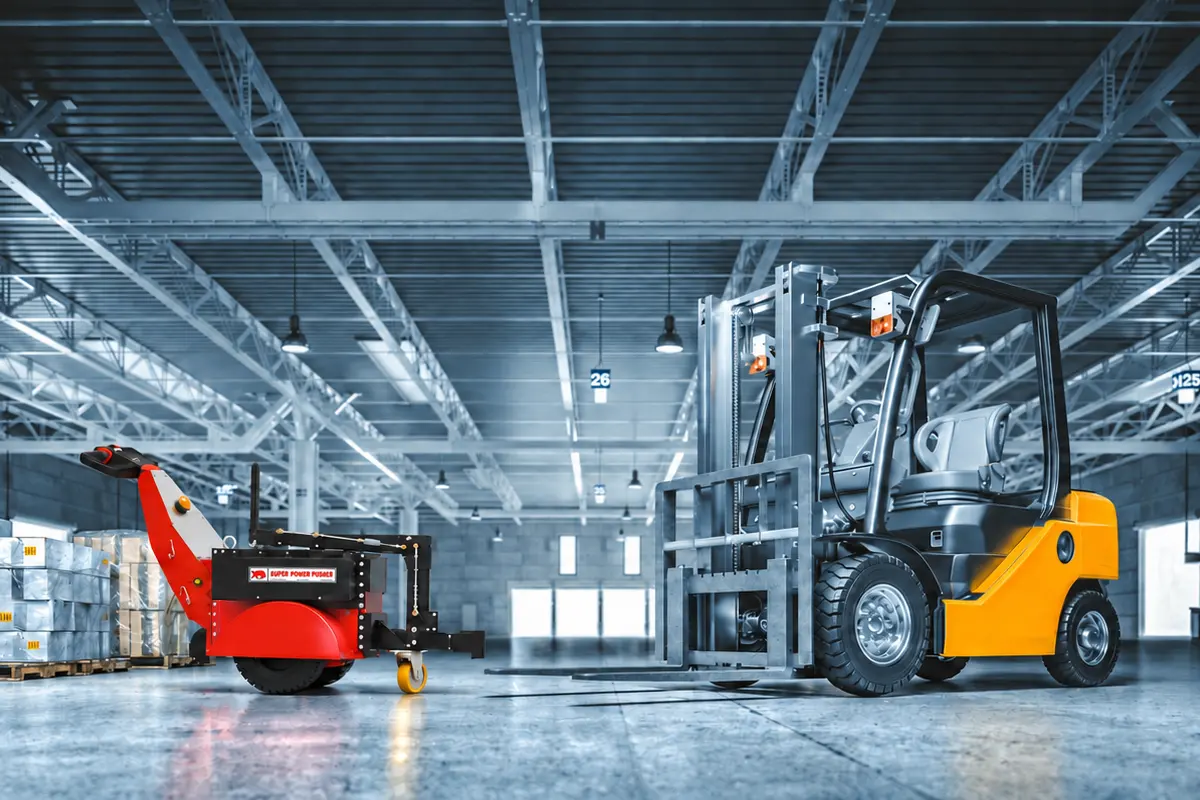
Electric PowerPushers help manufacturing teams move heavy wheeled loads more predictably and with less strain on operators.
Smooth, controlled movement for heavy loads
By adding powered assistance to wheeled carts and stillages, PowerPushers give one person the ability to move loads that used to require more staff. This lowers fatigue and reduces the chance of accidental slips or sudden movements.
Replacing inefficient handling methods
Using forklifts for short, repetitive internal moves can be inefficient and disruptive. Electric pushers keep forklifts focused on lifting tasks while handling everyday cart movement with precision.
Safer interaction across the production floor
PowerPushers give operators better control in tight spaces, reducing pinch points and improving safety for pedestrians sharing the workspace.
Helping materials arrive where they’re needed, on time
Consistent movement through production cells keeps workflows flowing and supports lean thinking without expensive automation.
Real-World Example: Hitachi Energy
One recent example shows exactly how this works in practice. At a major production facility in Łódź, Poland, the team at Hitachi Energy needed to improve how they moved heavy technological trolleys through their plant. These trolleys, loaded with aggregates weighing between roughly 2,000kg and 10,000kg, were essential to daily operations but hard to shift manually and challenging with traditional handling methods.


After investing in a Super Power Pusher electric tug with a steering arm attachment, the operation changed noticeably. The compact nature of the tug and its precision steering meant it could navigate the factory’s layout easily, even in tighter spots. What previously took three people to move could now be handled by one operator, saving time and effort and reducing the risk of strain or delay. As one Electrical Design Specialist put it, the machine had quickly become “an invaluable piece of kit for our employees.”
This isn’t just a productivity statistic. It’s a good example of how applying the right tool to a core handling task can reduce labour intensity and make daily work smoother and safer for people on the floor.
Typical Manufacturing Applications
In manufacturing facilities, PowerPushers are commonly used for:
- Moving stillages and palletised components between workstations
- Transporting tooling, jigs and dies
- Handling work-in-progress carts along production lines
- Positioning heavy equipment during changeovers or maintenance
- Moving finished goods to staging or dispatch areas


Because they work with existing wheeled loads, PowerPushers often integrate easily into current material handling routines without major changes to equipment.
Supporting a Smarter, Safer Workplace
Improving material handling doesn’t always mean big, costly automation projects. Sometimes it’s about equipping teams with tools that make everyday tasks less risky and more consistent.
Electric PowerPushers help reduce manual handling risks, give operators confident control of heavy loads and support smoother production flow. In manufacturing settings where movement is a constant, that combination adds up to better safety, better efficiency and happier teams.
Make an enquiry

Latest Updates
- Power Pusher vs forklift trucks: do you actually need to lift the load?
- Safer Paper Roll Handling in Paper Mills and Corrugator Plants
- Custom Electric Tugs: Tailored Solutions for Unusual Loads
- How the Power Pusher Range Can Support the Defence Industry
- Moving Heavy Loads on Rails Safely: Electric Tug Solutions for Rail Trolleys and Bogies
- Cable Drum & Paper Reel Handling: Safer Moving with Power Pusher Drum Pushers
- Hitachi Energy improves safe movement of production trolleys with the Super Power Pusher
- Material Handling Challenges in Manufacturing Facilities


